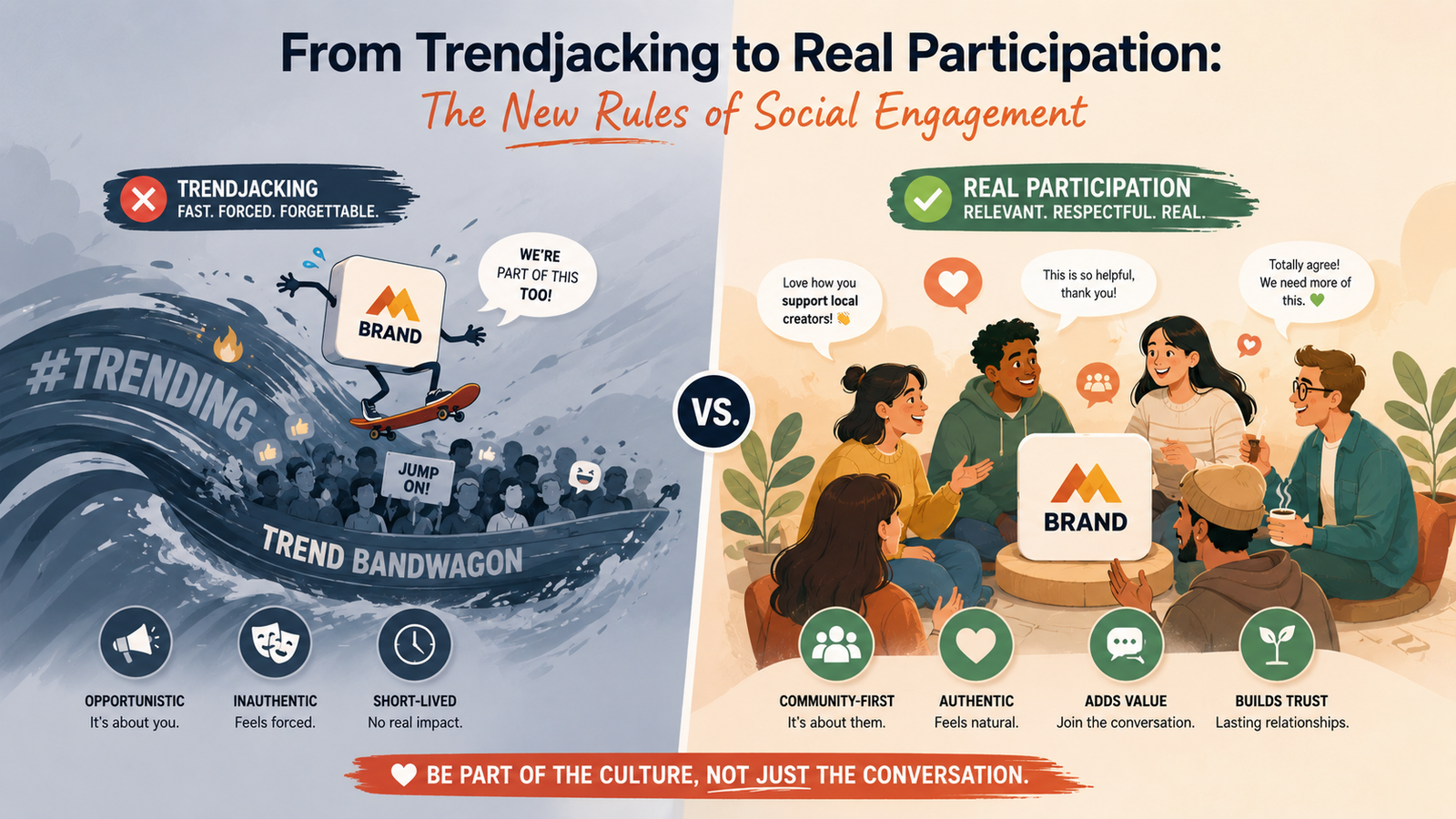
You’ve seen it. A brand spots a trending hashtag at 11 a.m. and by lunch they’ve posted a forced meme with their logo slapped on it. The comments are a mix of eye-rolls and silence. Engagement numbers look fine for about six hours. Then nothing. The team high-fives and moves on to the next trend.
That’s trendjacking. And most of the time it’s a waste of energy.
I spent years watching marketing teams chase every viral moment like it was free growth. Some of those posts got a temporary spike. Almost none of them built anything lasting. The brands that actually moved the needle weren’t the ones jumping on trends. They were the ones showing up in conversations that already mattered to their people.
Here’s the shift that actually works now: stop treating social as a billboard for clever reactions. Start treating it as a place where you participate.
Trendjacking feels productive. It rarely is.
The appeal is obvious. A big cultural moment happens. You insert your brand. You hope for residual attention. It looks fast and cheap.
But the reality is messier. Most trendjacking posts either get ignored or attract the wrong attention. People can smell the calculation. And algorithms have gotten better at noticing when engagement is shallow and short-lived.
I once worked with a mid-sized software company that jumped on every major tech or culture trend for almost a year. Their social team was exhausted. The posts performed “okay” by vanity metrics. Pipeline contribution? Near zero. When we finally pulled the data, the content that actually influenced deals were quiet, useful replies in niche LinkedIn threads and genuine participation in a couple of industry Slack communities. Not the memes.
Another example: a regional retailer tried to ride a national sports moment. The post was technically on-brand and well-designed. It got a few thousand likes from people who didn’t live near any of their stores. Actual foot traffic or online sales that week? Flat. Meanwhile, a smaller competitor simply answered customer questions in local Facebook groups with helpful, specific advice. That competitor saw a measurable lift in store visits.
Trendjacking optimizes for attention. Real participation optimizes for relevance and trust. Those are different games.
The new rules are simpler than the old playbook
You don’t need a 40-page social strategy deck. You need a different operating system.
1. Listen harder than you post
Most brands still treat social as a broadcasting channel with a comments section attached. Flip it. Spend more time reading than writing.
Pick the 3–5 places where your actual customers or prospects already talk. For some of you that’s LinkedIn groups or specific subreddits. For others it’s local Facebook groups, industry Discords, or even certain Instagram accounts. Go there daily. Not to drop links. To understand what’s frustrating people, what they’re celebrating, what language they use.
When you finally speak, you’ll sound like someone who’s been paying attention instead of someone who just checked the trending tab.
2. Join conversations. Don’t start them from scratch every time
The old approach was “create content and hope people engage.” The better approach is to find existing conversations and add something useful.
A B2B client of mine used to post three original LinkedIn updates a week. Engagement was polite but thin. We cut that back and redirected the energy. Every day the team spent 20–30 minutes finding relevant posts from prospects, partners, and industry voices. They left thoughtful comments that actually advanced the discussion—no “Great post!” or soft pitches.
Within two months their inbound messages from those same people increased noticeably. Some of those conversations turned into meetings. The original content they still posted performed better too, because the algorithm and the audience already recognized them as real participants.
You don’t always need to own the conversation. Showing up consistently in other people’s conversations builds more credibility than most branded posts.
3. Be useful or be human. Preferably both.
Cute is optional. Useful and human are not.
If you’re going to post, ask yourself: does this help someone do their job better, solve a specific problem, or make them feel less alone in a frustration? If the answer is no, reconsider.
The most effective social activity I’ve seen from brands in the last few years hasn’t been polished campaigns. It’s been the account manager who answered a technical question in a public thread with a clear explanation and a screenshot. Or the founder who admitted a recent product shortcoming and explained what they were changing. Those posts don’t always go viral. They do get saved, shared in private messages, and remembered when buying decisions happen.
4. Consistency beats the occasional big swing
One clever trendjack post might get more likes than your last ten regular posts combined. That spike is usually a distraction.
The brands that compound results show up in the same places, week after week, with a recognizable point of view. They reply. They ask follow-up questions. They share small observations. Over time people start recognizing the name and the voice. Trust accumulates slowly and then all at once.
I’ve watched companies abandon this approach the moment a “big opportunity” trend appears. They pour energy into the trend post, neglect the regular conversations for a few days, and lose the quiet momentum they had built. Don’t do that.
What usually doesn’t work (and why teams keep doing it)
A few patterns I keep seeing:
- Treating every cultural moment as a mandatory brand moment. It’s not. Sitting some of them out is often the smarter move.
- Measuring success only by reach or engagement rate on branded posts. If those metrics are rising while sales conversations and customer sentiment are flat, you’re optimizing the wrong thing.
- Outsourcing “engagement” to an intern or junior person with a checklist. Real participation requires judgment and some domain knowledge. You can’t fully template it.
- Posting first and listening second. This still happens constantly. The order matters.
There’s also a practical limit. Real participation takes more time per interaction than spraying trend posts. You can’t scale it the same way. That’s fine. Depth usually beats breadth in social right now.
Honest watch-outs
This approach is slower to show flashy numbers. If your leadership only looks at monthly reach charts, you’ll need to reframe the conversation around quality of conversations, pipeline influence, and customer feedback loops.
It also requires actual opinions and some willingness to be slightly imperfect in public. Brands that only speak in polished, risk-free language struggle with real participation. People can tell when the account is run by committee.
And it doesn’t mean never reacting to culture. Occasional, well-timed participation in a bigger moment can still work—if it fits your existing voice and you’ve already been present in the quieter conversations. The difference is that it becomes an extension of your normal behavior instead of a desperate reach for relevance.
Something you can try this week
Pick one community or platform where your customers already spend time. For the next five workdays, don’t post anything original from the brand account in that space. Just read and reply.
Leave at least three genuine comments or answers each day. No pitching. No linking back to your site unless someone specifically asks. Just be useful or curious.
At the end of the week, look at two things: Did anyone reply or continue the conversation with you? And did you learn something about your audience you didn’t already know?
That’s the baseline. Everything else builds from there.
Trendjacking will keep looking tempting because it’s visible and fast. Real participation is quieter and slower. It’s also the version that still works when the algorithm changes again next quarter.
