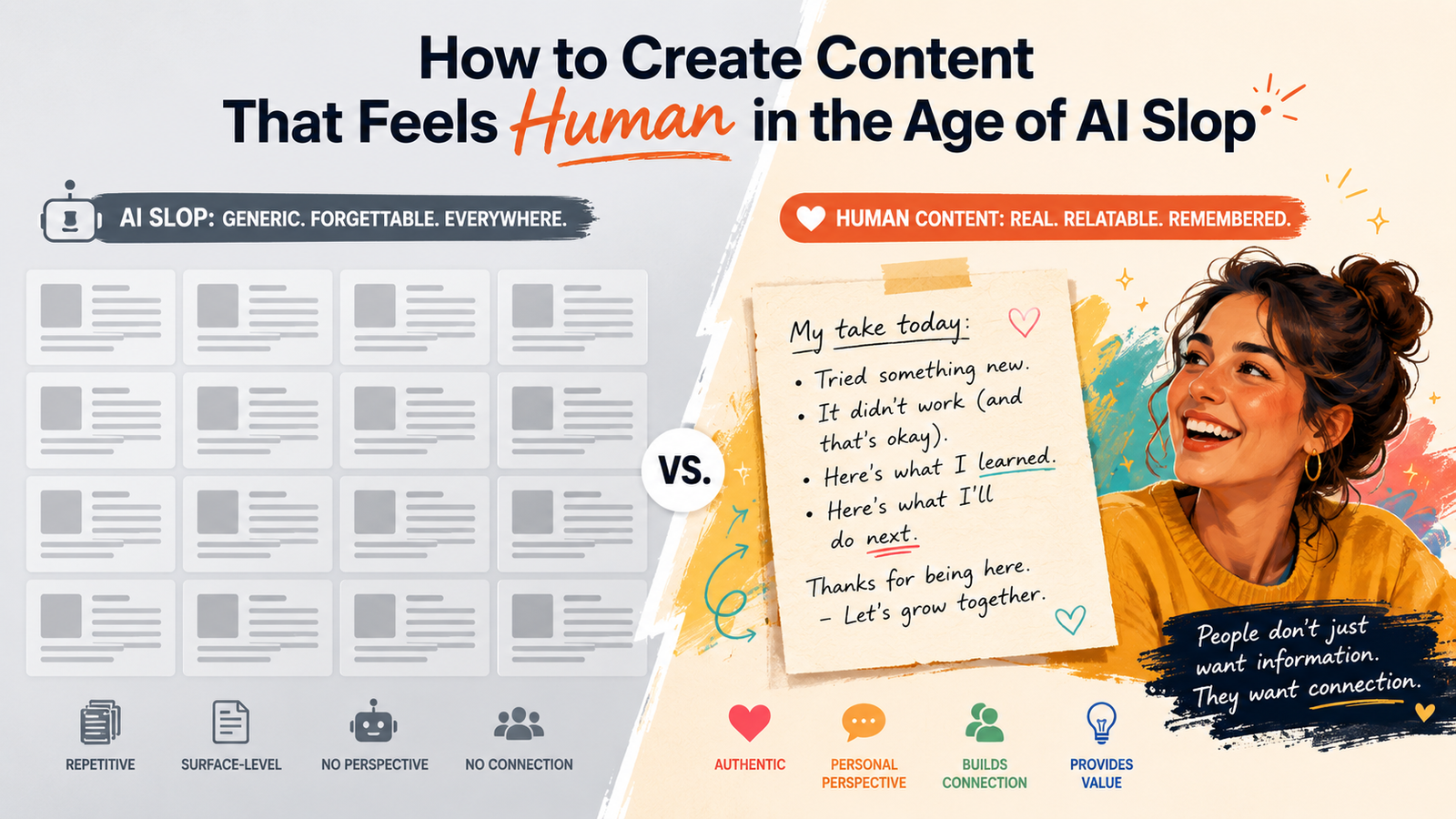
You open LinkedIn or your feed and it’s the same thing again. Perfectly structured posts. Clean headers. Zero personality. The same phrases recycled across industries. You can almost hear the prompt that made them.
That’s AI slop. And your audience is getting better at spotting it every week.
Marketing managers and business owners I talk to are stuck. They know they need more content. They know pure manual production is slow and expensive. So they turned to AI tools. Then they watched engagement drop, comments go silent, and search rankings stall. The content looks professional. It just doesn’t feel like it came from a real person who has done the work.
I’ve been in digital marketing for over a decade. I’ve watched this cycle before with template-driven content, then with formulaic “10 tips” posts, and now with AI. The pattern is the same. When everything starts sounding the same, the stuff that still sounds human wins.
Here’s how to make content that actually feels human without pretending AI doesn’t exist.
Stop Treating AI as a Writer
Most teams use AI the wrong way. They feed it a topic, get a full draft, lightly edit the obvious errors, and publish. That produces clean, empty content.
I saw this play out with a mid-size B2B software client last year. They generated 40 blog posts in a month using AI. All keyword-optimized. All properly structured. Traffic went up for about six weeks. Then it flatlined. Bounce rates climbed. Time on page dropped. The sales team started complaining that inbound leads felt colder than usual. When we pulled a sample of the posts and compared them to the company’s actual customer conversations, the gap was obvious. The content talked about “solutions” and “efficiency.” Real customers talked about the specific Friday afternoon panic when a system went down and the relief when someone actually fixed it fast.
AI is excellent at structure, speed, and first drafts. It is terrible at lived experience, specific opinion, and the small details that make writing feel true. Treat it like a junior researcher or a very fast outline tool. Not the writer.
What Actually Makes Content Feel Human
Human content has friction. It has uneven edges. It includes things that a pure language model would smooth out because they feel inefficient.
A few markers I look for:
- Specific numbers and timelines that only come from real work. “We tested this with 12 clients over three months and lost two of them in the first week” hits different than “results may vary.”
- Clear opinions. Not “it depends.” Actual stances. “This approach usually fails for companies under 50 people.”
- Small, concrete details. The way a founder’s voice changes when they talk about their first failed product. The exact phrase a customer used on a call that revealed the real problem.
- Admissions of what didn’t work. Most AI content skips this. Real people don’t.
When content has these, readers lean in. When it doesn’t, they skim and leave.
Practical Ways to Keep the Human Signal
Here’s what actually works when you’re busy and still need volume.
Start with the ugly first version yourself.
Before you open any AI tool, write 150–300 rough words from memory or notes. Just the core point, one example, and your actual opinion. Don’t polish it. Then feed that to AI and ask it to expand or restructure around your material. The difference is immediate. The piece keeps your voice and judgment instead of inventing a generic one.
Steal from real conversations.
Your best material is already sitting in sales calls, support tickets, customer interviews, and Slack threads. I once worked with an e-commerce brand that was struggling with generic product content. We started recording short debriefs after every major customer call. Not formal interviews. Just five minutes of “what did they actually say?” One founder mentioned that customers kept comparing their product to a specific childhood experience. That single detail became the opening of three of their highest-performing pieces. No AI would have invented that.
Build a small library of your own patterns.
Keep a running note of phrases you use in conversation, objections you hear repeatedly, and results that surprised you. When you brief AI or edit, drop those in. Over time this becomes a private style guide that no public model has.
Edit for voice last, not first.
Most people edit AI output for grammar and SEO first. Flip it. Read the draft out loud. Mark every sentence that sounds like it could have come from any other company in your space. Rewrite those. Keep the ones that sound like something you would actually say to a smart colleague.
Use AI for the parts humans hate.
Outlines. Research summaries. First-pass keyword integration. Alternative headlines. Table formatting. Leave the judgment, stories, and final wording to people who have skin in the game.
What Usually Doesn’t Work
A few approaches I keep seeing fail:
- Publishing high volumes of lightly edited AI content and hoping quantity wins. Search engines and readers both notice the pattern. Engagement metrics drop first. Rankings follow.
- Trying to “humanize” by adding emojis, forced humor, or exclamation points. That’s not human. That’s costume.
- Asking AI to “write in a conversational tone” without giving it your actual material. It produces a simulated conversational tone that still feels hollow. The model is good at mimicking surface features. It is not good at generating genuine point of view.
- Hiding the fact that AI was involved when the content is clearly formulaic. Audiences aren’t stupid. Transparency about process is less damaging than pretending the polished generic post came from deep human insight.
Honest Limitations
This approach is slower than pure AI production. You will publish less in the short term. That’s the trade-off. The content that does go out tends to perform better on the metrics that matter: time on page, comments that go beyond “great post,” and actual pipeline influence.
It also requires people who have real experience with the topic. If your team has never spoken to customers or run the campaigns themselves, no process will fix that. AI will just amplify the emptiness.
And yes, some pure AI content still ranks for low-competition, high-intent informational queries. That window is closing as more of the web fills with similar material. The defensible ground is shifting toward content that only someone who has done the work could write.
Try This Week
Pick one piece of content you need to produce in the next seven days. Before you touch any AI tool, open a blank document and write three things from memory:
- The single most useful thing you’ve learned about this topic from actual work.
- One specific example or failure (yours or a client’s) that illustrates it.
- Your current opinion on the common advice around it—what usually gets overstated or understated.
Then use AI only to expand and structure around those three points. Edit the result by reading it out loud once. Publish it.
That’s it. One piece. Real material first. Measure the difference in how people respond compared to your recent AI-heavy posts.
The companies that treat human experience as the scarce resource and AI as the amplifier will keep an edge. The ones that treat AI as the main writer will keep producing content that looks fine and feels forgettable.
The bar isn’t perfection. It’s just sounding like someone who has been in the room.
