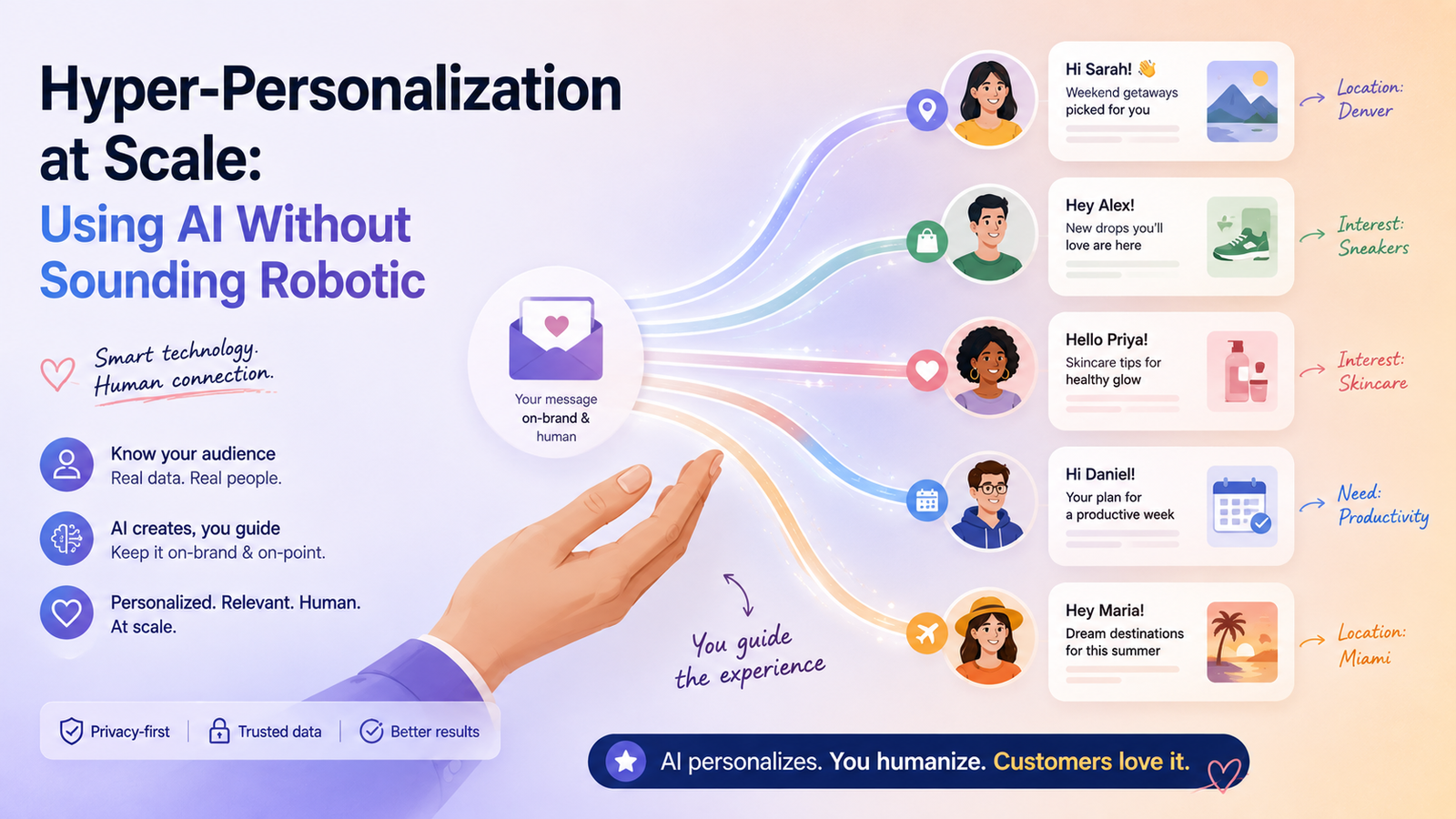
You’ve got the tools. You’ve got the data. You’ve got the budget for the latest AI personalization platform. And still, half the emails going out sound like they were written by a polite but slightly unhinged intern who never met an actual customer.
That’s the frustration I hear every week from marketing managers. They want relevance at scale. What they get is first-name mail merges dressed up as “hyper-personalization,” product recommendations that feel random, and messages that somehow manage to be both generic and creepy at the same time.
Here’s the thing. The problem isn’t the AI. It’s the way most teams use it.
Hyper-personalization was never supposed to mean this
Real hyper-personalization isn’t stuffing every available data point into a sentence. It’s making the right person feel like you understand their specific situation right now. Timing. Context. Tone that matches how your best humans already talk to customers.
Most AI setups skip that part. They treat personalization like a Mad Libs exercise. Pull the last product viewed, the city, the open rate, and drop them into a template. The result is technically accurate and emotionally flat. People notice. They unsubscribe. Or worse, they ignore you.
I once watched a mid-size ecom brand spend six figures on an AI recommendation engine. The system started pushing heavy winter jackets to customers in Texas in late April because those same people had bought a coat the previous November. Technically correct purchase history. Completely tone-deaf to season and location. Returns spiked. Support tickets complained about “weird suggestions.” The team blamed the data. The real issue was they let the machine decide the message without any human filter for common sense.
Why most AI personalization still sounds robotic
Three patterns keep showing up.
First, teams hand the AI a brand voice document that reads like a corporate mission statement and expect magic. AI is good at pattern matching. It’s not good at reading between the lines of “we are innovative yet approachable.” If your human writers don’t already have a clear, lived-in way of talking, the machine will default to safe, bland, slightly formal language.
Second, people treat the first draft as the final draft. They generate, glance, hit send. That’s how you end up with subject lines that feel calculated instead of useful.
Third, the data is usually incomplete or out of date, and nobody builds rules to protect against that. AI will confidently personalize on stale signals if you let it.
Look. AI is excellent at scale and speed. It is terrible at judgment. Judgment is still a human job.
Treat AI like a very fast junior, not the creative director
The teams getting this right follow a simple rule: AI does the heavy lifting on research, segmentation, and first drafts. Humans own the final voice and the decision to send.
Here’s a practical way to set it up.
Start with your best-performing human-written content. Pull 20–30 emails, landing pages, or SMS messages that actually converted and felt on-brand. Feed those to the AI as examples of “how we sound when we’re good.” Most tools let you do this now. Do it. Don’t skip it.
Next, define hard boundaries. What the AI is never allowed to say. No inventing urgency that isn’t real. No referencing purchases older than X days without a clear reason. No assuming emotional states (“we know you’re frustrated…”). These guardrails stop the most common robotic failures before they start.
Then generate in batches, not one-off. Ask the AI for three versions of the same message aimed at different segments. Read them side by side. You’ll immediately see where it defaults to the same phrases. Cut those. Keep the structure that works and rewrite the lines that feel off.
One B2B client I worked with was sending AI-generated LinkedIn outreach that opened with “I noticed your company is scaling rapidly in the [industry] space.” Every single message. It was true for some prospects and completely wrong for others. We switched the process. AI pulled recent company news and role changes. A human spent 90 seconds scanning the draft and rewriting the first two sentences to match the actual context. Reply rates nearly doubled. The extra time per message was tiny compared with the cost of looking like spam.
Practical moves you can make without overhauling everything
You don’t need a new platform to improve this. Start with what you already have.
Use AI to surface the insight, then write the line yourself. Instead of asking it to “write a personalized email about abandoned carts,” ask it to list the three most common product categories left in carts for high-value customers in the last 14 days, along with any pattern in time-of-day or device. Then you write the email. The insight is sharper. The voice stays yours.
Build a simple “human check” step for anything customer-facing that uses more than basic merge tags. One person on the team skims the top 10% of personalized sends each week. They’re looking for two things: does this sound like us, and would this feel helpful if it arrived in my inbox? Catch the weird ones early.
Test the difference. Take one segment and run two versions of the same campaign. Version A is pure AI output with light review. Version B is AI-assisted but heavily rewritten by a human who knows the customer. Measure not just open and click rates, but replies and unsubscribes. The gap is usually bigger than people expect.
And stop personalizing on single data points. One purchase or one page view is not a relationship. Combine signals or don’t bother. A customer who browsed hiking boots and also lives in a city with recent snowfall is a better bet for a relevant message than someone who simply looked at boots six weeks ago.
What usually doesn’t work (and why you should skip it)
- Fully automated sequences with zero human review. These almost always drift into robotic territory within a few weeks as the AI keeps optimizing for the wrong signals.
- Over-personalization that references private or sensitive details. Just because the data exists doesn’t mean it belongs in an email. Customers notice when you know too much and say it awkwardly.
- Chasing perfect one-to-one messaging before you’ve fixed the basics. If your regular emails already sound generic, AI will just make the generic version more efficient. Fix the core voice first.
- Data quality is the quiet killer. If your CRM is full of incomplete profiles and old purchase records, the AI will personalize on garbage. Clean the data that matters before you scale the personalization.
The honest limits
AI still makes confident mistakes. It will invent connections that aren’t there. It will miss sarcasm, cultural context, and timing. It cannot feel the difference between a helpful reminder and a pushy one. That’s why the human layer stays non-negotiable.
Privacy rules keep tightening. Using behavioral data at scale means staying current on consent and retention. The teams that treat this as a legal checkbox instead of a trust issue eventually pay for it.
And scale has a cost. The more personalized the system becomes, the more maintenance it needs. Segments drift. Models need retraining. Someone has to own that ongoing work or the whole thing slowly degrades into the robotic mess you started with.
Try this one thing this week
Pick one automated email or SMS that currently uses AI or heavy merge tags. Generate the next version the way you normally would. Then rewrite only the first three sentences yourself, using the same data but making it sound like something a sharp colleague would actually say. Send both versions to a small test group if you can, or just compare them side by side with your team.
You’ll feel the difference immediately. That’s the gap between hyper-personalization that works and the version that makes people hit unsubscribe.
Most of the heavy lifting can stay with the machines. The judgment, the voice, and the final call on whether something feels human still belong to you. Keep it that way.
