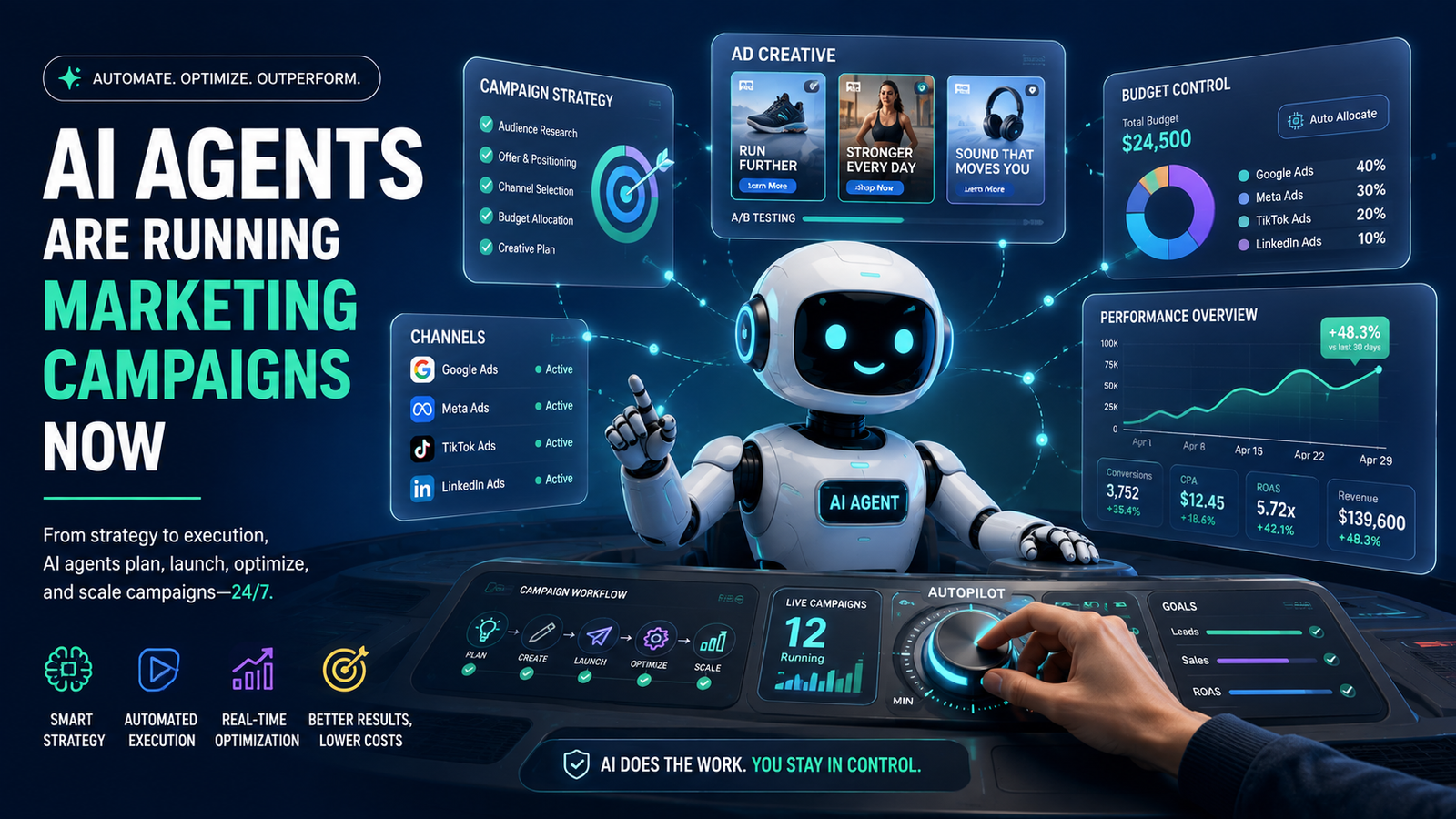
You’ve seen the demos. An AI agent that “builds and optimizes entire campaigns while you sleep.” Another one that “handles your media buying, creative testing, and reporting automatically.” Your inbox is full of pitches from tools and agencies claiming they’ve handed the keys to the machine.
And yet most of the marketers I talk to still feel the same Monday-morning dread. Campaigns underperform. Budgets get wasted. Reports look impressive but don’t explain why anything actually worked.
Here’s the thing. AI agents are running parts of marketing campaigns right now. Not in the sci-fi way the sales decks promise. In quieter, more useful, and sometimes more dangerous ways. If you’re a marketing manager or business owner trying to figure out what’s real and what’s noise, this is the practical version.
What people actually mean by “AI agents”
Most of the tools calling themselves agents are not fully autonomous systems making high-stakes decisions without oversight. They’re more like persistent workflows with memory and tools attached.
An agent can research audiences, draft ad variations, push them into ad platforms, pull performance data, decide which ones to kill, and write a summary. Some can even adjust budgets within guardrails you set. That’s different from a simple ChatGPT prompt or a static automation rule in your ad account.
The useful ones keep context across steps. They don’t just generate one piece of copy and stop. They iterate. They notice that a certain angle worked better on mobile last week and try something similar this week.
But they’re still tools. They don’t understand your brand the way a good strategist does. They don’t feel the awkwardness of a tone that lands wrong with your actual customers. And they definitely don’t own the P&L.
Where agents are already doing real work
I’ve watched three clear use cases deliver results without the drama.
First, creative testing at volume. A mid-size e-commerce brand I advised last year was stuck testing 4–6 ad concepts a month because their designer and copywriter were maxed out. They set up an agent that took a product brief, generated 20–30 angle-and-visual combinations, uploaded them into Meta’s Advantage+ creative tests, monitored the first 48 hours of spend, and paused the clear losers. The human team only reviewed the top performers and refined the winners. Their cost per purchase dropped 22% in six weeks, mostly because they stopped wasting money on weak concepts that used to run for days.
Second, email and lifecycle sequences. One SaaS company had a classic problem: their onboarding emails felt generic and their reactivation campaigns were basically “Hey, we miss you.” An agent now pulls recent product usage data, customer support tickets, and previous open/click patterns, then drafts personalized sequences for different user segments. A marketer still reviews and edits the final version before it goes out. Open rates on the reactivation series jumped from the mid-teens to the high 20s. Nothing magical. Just tighter relevance at scale.
Third, competitive and keyword monitoring for paid search. A local services business used to check Google Ads auction insights and competitor landing pages once a week if they were lucky. Now an agent scans daily, flags unusual competitor activity or sudden CPC spikes on core terms, and drafts suggested responses (bid adjustments, new negative keywords, or counter-ad copy). The owner spends ten minutes each morning reviewing the agent’s notes instead of an hour digging through reports.
Notice the pattern. In every case the agent handles volume, speed, and first-pass analysis. A human still sets the strategy, defines the guardrails, and makes the final call on brand and risk.
What usually doesn’t work
Handing an agent the entire media budget and walking away is a reliable way to lose money fast. I saw a founder do exactly that with a new “autonomous media buyer” tool. Within three weeks the agent had chased cheap traffic that looked good on surface metrics but converted at a third of the previous rate. The founder only noticed when the sales team started complaining about lead quality. By then they’d burned through most of the month’s budget.
Another common failure: treating agent output as finished work. Agents are excellent at producing options. They’re average at judgment. If you start publishing unedited agent-written emails or ad copy, your brand voice slowly turns into the average of the internet. Customers notice. Trust erodes quietly.
And then there’s the reporting theater. Some agents generate beautiful weekly summaries that sound insightful but never surface the real reasons performance moved. They’ll tell you “engagement improved 18%” without connecting it to a specific creative change or audience shift. You end up with more dashboards and less clarity.
Practical rules that keep you out of trouble
Start narrow. Pick one repetitive, high-volume task that currently eats human time and has clear success metrics. Creative testing, first-draft email sequences, or daily competitive monitoring are good candidates. Don’t start with “run the whole campaign.”
Set hard guardrails before you turn anything on. Maximum daily spend the agent can move. Brand voice examples it must match. Audiences it is not allowed to target. Keywords or claims it cannot use. Write these rules down like you would for a junior hire.
Review early and often at the beginning. In the first two weeks, look at everything the agent produces. You’ll quickly see its blind spots. After that you can move to exception-based review—only look when performance drifts or the agent flags something unusual.
Keep a human responsible for the outcome. The agent can suggest budget shifts. A person still has to own the result when the CFO asks why CAC went up.
Measure the right things. Don’t just track how much time the agent saved. Track whether the work it produced actually improved the metrics that matter to the business: cost per qualified lead, customer acquisition cost, retention, or revenue.
How to try this without buying another expensive platform
You don’t need a six-figure “AI marketing OS” to start.
This week, pick one campaign or channel that feels repetitive. Take the last 30 days of performance data and the creative or email that performed best. Feed that into a solid general AI tool with clear instructions: “Based on this data, generate 8 new ad angles that follow the same structure as the winner but test different emotional hooks. Keep the brand voice from these three example posts. Flag any claims that feel risky.”
Review the output yourself. Pick two or three. Launch them with a small controlled budget. Compare results after 72 hours against your normal process.
That’s it. No new software contract. No committee meetings. Just a controlled test of whether an agent-style workflow improves the work you’re already doing.
Most marketers who try this discover two things quickly. First, the agent is faster and sometimes more consistent at generating options than a tired human on a Thursday afternoon. Second, the human still has to decide which options are worth testing and when to stop.
The ones who get real value treat agents like very fast junior team members with perfect memory and zero ego. They give clear briefs. They correct mistakes early. They don’t promote the junior to CMO.
AI agents are already inside marketing campaigns. The question isn’t whether they’ll be involved. It’s whether you’ll use them for the parts of the job that benefit from speed and volume, while keeping the judgment, brand sense, and accountability where they belong.
That’s the practical version. No hype required.
