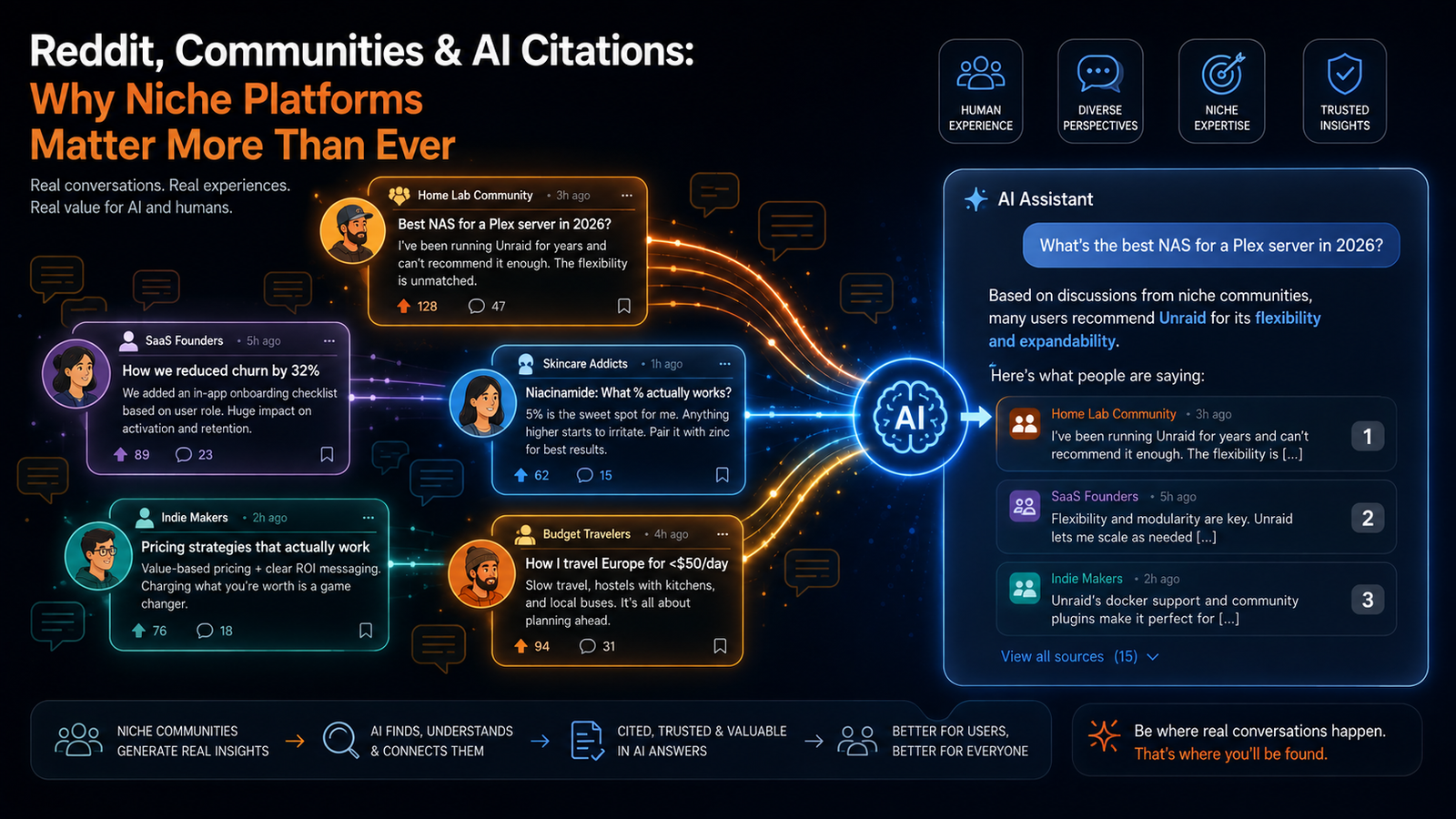
You’re publishing solid blog posts. You’re tracking rankings. You’re doing the work Google used to reward. And yet traffic feels softer than it should.
Here’s the quiet part most marketing decks still skip: when someone asks an AI tool a specific question, the answer often pulls from a Reddit thread or a niche forum, not from your carefully optimized article. That shift is already happening. And if you’re still treating communities like a side channel, you’re leaving real visibility on the table.
I’ve watched this play out with clients for a couple of years now. The pattern is consistent. Brands that show up in the right conversations get cited. Brands that only publish on their own site get ignored by the machines that increasingly sit between the user and the search results.
AI tools are reading the same places real people talk
Large language models and AI search products need sources that feel current, specific, and human. Polished brand content often fails that test. A two-year-old Reddit thread where someone describes exactly how a product failed in the field, or how a workaround finally solved the problem, passes it.
Look at what happens when you ask Perplexity, ChatGPT, or Google’s AI Overviews a practical question in a specialized category. You’ll frequently see citations from Reddit, Stack Exchange, or industry-specific forums. Not because those platforms paid for placement. Because the content is dense with real experience and natural language.
I once sat with a mid-size outdoor gear brand that had spent years building a content library around backpacking. Their posts ranked decently. Then we started checking AI answers to questions like “best ultralight tent for wet climates” or “how to fix a stuck zipper on a rain jacket.” Competing products kept appearing because regular users had written detailed answers in r/Ultralight and r/camping. The brand’s own content almost never showed up. They weren’t being outranked by better SEO. They were being out-discussed.
That’s the new reality. Niche platforms win on authenticity signals that polished marketing still struggles to fake.
Traditional channels are getting noisier while these places stay quieter
Most marketing teams still pour energy into LinkedIn, Instagram, and the same few content formats. Those channels are crowded. Algorithms change. Reach drops. Everyone is fighting for the same attention.
Reddit and specialized communities work differently. The barrier is higher. You can’t just schedule posts and walk away. You have to actually participate. That friction keeps the signal cleaner. People notice when someone keeps showing up with useful answers instead of promotional noise.
But here’s what usually doesn’t work. Dropping your blog link in a subreddit and hoping for upvotes. Creating a throwaway account to push product. Writing posts that read like press releases. Communities smell that immediately. The downvotes come fast, and in some cases the ban follows. I’ve seen marketing managers try the “just share value” approach for two weeks, get frustrated when nothing happens, and abandon it. Consistency is the entire game.
Real examples of what actually moves the needle
One SaaS client in the project-management space started answering questions in a few relevant subreddits and a couple of specialized Slack communities. No product links for the first three months. Just clear explanations of common workflow problems. After a while their product name started appearing in organic answers. Then AI tools began citing those threads when users asked about alternatives to bigger platforms. The traffic wasn’t huge at first, but the quality of the leads that came through was noticeably higher. People arrived already half-sold because they’d seen real users discuss the tool.
Another case: a small manufacturer of specialty kitchen tools. Their founder began spending 20–30 minutes a few times a week answering questions in cooking and baking communities. He never led with the product. He just solved problems. Over time other users started recommending the tools unprompted. Those mentions later showed up in AI-generated shopping and recommendation answers. The founder told me it felt slow and almost invisible for the first six months. Then the citations started compounding.
The common thread in both cases was patience and restraint. They treated the communities as places to be useful, not as distribution channels.
Practical steps that don’t require a full-time community manager
You don’t need a big team. You need a repeatable habit.
Start by mapping the 3–5 most relevant communities for your category. Reddit is usually the highest-leverage starting point because of how often it appears in AI citations, but don’t ignore specialized forums, Discord servers, or niche Facebook groups if they’re active and serious.
Next, create accounts that look like real people. Use a consistent username. Fill out a basic profile. Lurk for a week or two so you understand the tone and the unwritten rules. Every community has them.
Then begin answering questions where you have genuine expertise. Keep the answers specific and practical. If someone asks about a common pain point your product solves, explain the problem and the solution without naming the product. Once you’ve built some credibility, you can mention tools more naturally—but only when it actually helps.
Set a simple weekly target. Thirty to sixty minutes, two or three times a week, is enough to start. Track which threads get engagement and which ones later appear in AI answers. Tools that monitor brand mentions and Reddit activity make this easier, but even a simple spreadsheet works at the beginning.
Watch the language people use. The exact phrases and questions that show up in communities often become the queries that AI systems later surface. That gives you better material for your own content too—just written in the way real users actually talk.
Honest limitations and things that can go wrong
This approach is not fast. You will not see a traffic spike in 30 days. If your boss needs immediate numbers, this channel will frustrate them. It’s better treated as a medium-term authority play.
Scale is also limited. One person can only cover so many communities well. Trying to industrialize it with multiple accounts or automated posting almost always backfires. Communities notice patterns.
Not every niche has a healthy, active community. Some categories are sparse. In those cases the return is lower and you may need to look at adjacent spaces or focus more on forums and Discord.
There’s also reputational risk. One bad interaction or a poorly timed product mention can create lasting negative sentiment in a small community. The fix is simple: stay helpful longer than feels comfortable, and never argue in public if someone criticizes your product.
Finally, Reddit itself is not static. Rules change. Subreddits rise and fall. You have to stay present enough to notice when the useful conversations move.
What you can do this week
Pick one subreddit or niche community that matches your product or service. Spend 20 minutes reading recent posts. Find two questions you can answer with useful, specific information. Post the answers without any links or product mentions. Note the date and the thread.
Do that twice more this week. That’s it. No strategy deck required. Just show up and be useful.
Most marketers will keep chasing the same crowded channels and wondering why AI answers keep citing someone else. The ones who treat niche communities as a serious part of their visibility work will quietly start showing up in the places that matter more every month.
The platforms that feel unsexy to marketers are the same ones AI systems trust. That gap is still open. It won’t stay open forever.
