You spend real time making something decent. A blog post. A webinar recording. A solid case study. You hit publish, watch a handful of likes roll in, and then… nothing. The piece sits there. Reach stays stuck.
Most teams respond the same way. They take that one asset, chop it into random clips, paste the same paragraph into LinkedIn and email, and call it repurposing. Then they wonder why nothing moves.
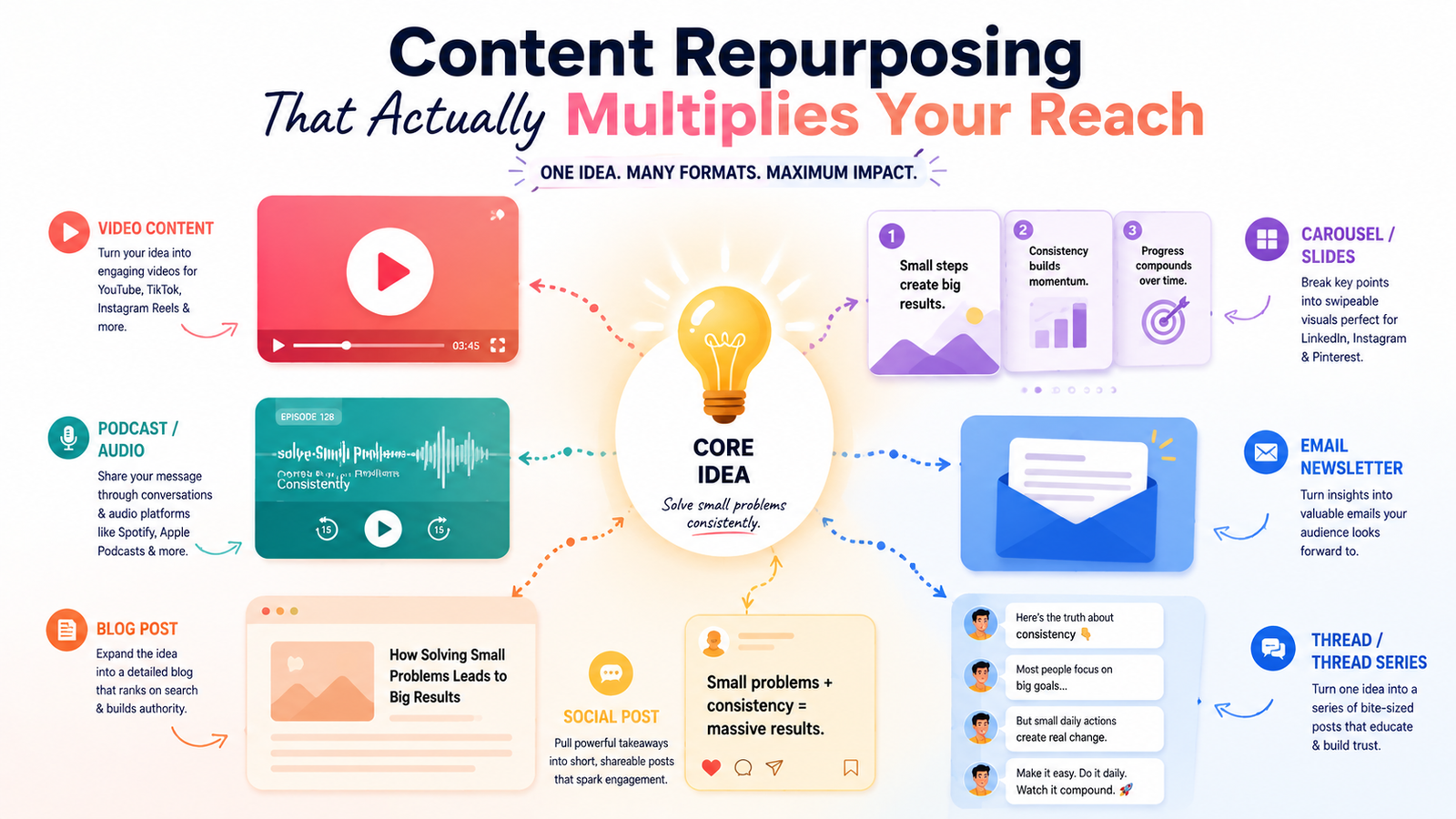
Here’s the truth from ten-plus years of doing this work: lazy repurposing multiplies noise, not reach. The version that works treats the original piece as raw material. You pull the strongest idea out of it and rebuild that idea for how people actually pay attention on each channel.
Not the same words. Not the same length. Not the same tone. Different shapes of the same point.
Why most “repurposing” fails
I once watched a mid-sized B2B company record a 45-minute product webinar. Decent attendance. Good questions. Their content person cut six random 30-second clips, slapped the same caption on LinkedIn, Instagram, and Twitter, and scheduled them over two weeks. Engagement was flat. A few polite comments. Zero pipeline movement.
The problem wasn’t the webinar. The problem was treating every channel like a dump site for leftover footage. People on LinkedIn scroll for insight they can use at work. Instagram users want something they can absorb in three seconds while standing in line. Twitter (or X) rewards sharp takes and threads that feel like a conversation. Same clip, same caption, same result: ignored.
Another pattern I see constantly: teams pull three bullet points from a blog and drop them into an email newsletter with almost no rewrite. Then they complain that open rates keep dropping. Of course they do. Your subscribers already saw the longer version or something close to it. You’re not giving them a new reason to care.
Real multiplication happens when you change the form, the framing, and sometimes the entry point of the idea. The core point stays the same. Everything around it gets rebuilt.
Start with one strong core, not a pile of leftovers
Pick one piece that already performed reasonably well or that contains a clear, useful idea. Don’t start with your weakest content. Weak ideas stay weak no matter how many formats you force them into.
Ask three questions:
- What is the single most useful or surprising point in this piece?
- Who needs that point, and where do they already spend attention?
- What would make that same point feel native on each of those places?
That’s it. No complicated frameworks. Just those three.
I worked with a founder who had written a long, slightly dry blog post about how his team cut customer onboarding time by 40%. The post got modest traffic. We pulled the core story: the specific three process changes that made the biggest difference, including the one that felt counter-intuitive at first.
From that one idea we made:
- A LinkedIn carousel that walked through the three changes with one concrete number on each slide.
- A short email that led with the counter-intuitive change and linked back to the full post for the details.
- A Twitter thread that started with the result and then listed the three moves in reverse order of obviousness.
- A 90-second talking-head video for YouTube Shorts and Instagram Reels where he just told the story out loud, no slides.
- One quote graphic with the single most interesting line for people who only scroll images.
None of these were copy-paste jobs. The carousel used different language and visual hierarchy. The email assumed the reader might never click through. The thread played to how people actually read on that platform. The video used spoken rhythm instead of written sentences. Same core idea. Five different useful versions.
That sequence produced more total engagement and more qualified conversations than the original post ever did on its own. Not because of some secret algorithm trick. Because the idea finally showed up in forms people were willing to consume.
Practical adaptation rules that actually work
Different channels reward different things. Ignore that and you waste the effort.
People here are in work mode, even when they’re half-scrolling. Carousels, short text posts with a clear takeaway, and native video under two minutes tend to travel farther than long external links. Rewrite the idea so the value is visible in the first two lines. Use the rest of the post or the carousel to expand. Don’t start with “I’m excited to share…” Just start with the point.
Your list already knows you (or at least opened the door once). Treat the email as a personal note, not a press release. Lead with one specific insight or story pulled from the original piece. Keep it shorter than the source. Make the click optional. Many people will get the full value from the email alone. That’s fine. The goal is usefulness, not forced traffic.
Short-form video (Reels, Shorts, TikTok)
Talk like a person, not a marketer. One idea. One concrete example. No long setup. The first three seconds decide everything. If the original piece was written, record yourself saying the key point in plain language. If it was already video, cut to the moment that actually lands and rebuild the surrounding context so it stands alone.
X / Twitter
Threads still work when they feel like thinking out loud. Start with a clear claim or result. Then walk through the reasoning or steps in short posts. End with a question or a single sharp takeaway. Avoid the “1/12” style that feels like a lecture. Write each post so it could almost stand alone.
Other owned channels (blog comments, community posts, sales decks)
Sometimes the highest-value version isn’t public at all. I’ve seen teams pull the strongest customer story out of a case study and drop a tightened version into the middle of a sales deck. That one slide closed more deals than the original PDF ever influenced. Repurposing includes internal use.
What usually doesn’t work (and why you should stop)
- Copy-pasting the same paragraph across platforms. Algorithms notice. Audiences notice faster. It signals low effort.
- Turning every long piece into “10 tips” just because lists feel easy. If the original idea wasn’t a list, forcing it into one usually waters it down.
- Repurposing only the easy formats and ignoring the ones that take a bit more work. Video and carousels often reach people who never read the long version. Skipping them leaves reach on the table.
- Measuring success only by vanity numbers on the secondary pieces. Watch for replies, saves, profile visits, and actual conversations started. Those matter more than raw impressions.
One more common mistake: waiting until the original piece is completely dead before doing anything with it. The best window is usually while the idea still has some momentum or while the topic is still relevant. Don’t wait six months.
Honest limits
This approach takes more time than pasting the same text into three tools. If you only have twenty minutes a week for content, you may only be able to create one or two adapted versions. That’s still better than zero.
Not every original piece deserves this treatment. Some content is thin or purely timely. Don’t force it. Save the effort for ideas with real substance.
And results are never automatic. A weak core idea stays weak. Strong adaptation multiplies a good idea. It doesn’t magically invent one.
What you can try this week
Pick one existing piece from the last three months that has a clear, useful point. Spend 45–60 minutes pulling that single point and writing three versions:
- A LinkedIn post or short carousel outline that leads with the insight.
- A short email version that could stand alone.
- Either a thread outline or a 60–90 second video script in your own spoken words.
Publish one of them. Watch what happens for a few days. Notice which version gets the most real responses, not just likes.
That’s the start. Once you see the difference between dumping the same content everywhere and actually adapting it, the rest becomes obvious.
Most teams already have more good ideas sitting unused than they realize. The reach problem is rarely a shortage of content. It’s a shortage of useful versions of the content they already made.
