You’re already tired of the pitch. Every conference deck and agency email keeps saying the same thing: attention is fragmented, screens are exhausting people, and the next wave is immersive. AR. Spatial. Experiences that pull people out of the feed.
Most of it feels like recycled hype. You’ve seen the cycle before—VR headsets that never left the living room, metaverse storefronts that sat empty, filters that got a weekend of shares and then vanished. So you keep running the same ads, the same landing pages, the same email sequences. And the numbers keep getting harder.
Here’s the thing. The frustration is real. Attention really is shifting. Not because of some distant sci-fi future, but because people are quietly rejecting passive scrolling. They want something that feels useful or fun the second they interact with it. And brands that keep treating every touchpoint like a static billboard are going to feel the squeeze first.
The real problem isn’t technology. It’s habit.
Most marketing still assumes the customer will stop, look, and decide in a linear way. Open ad. Click. Land on page. Convert. That path is getting noisier every year. Feeds are denser. Ad load is higher. And people have gotten very good at ignoring anything that doesn’t immediately reward them.
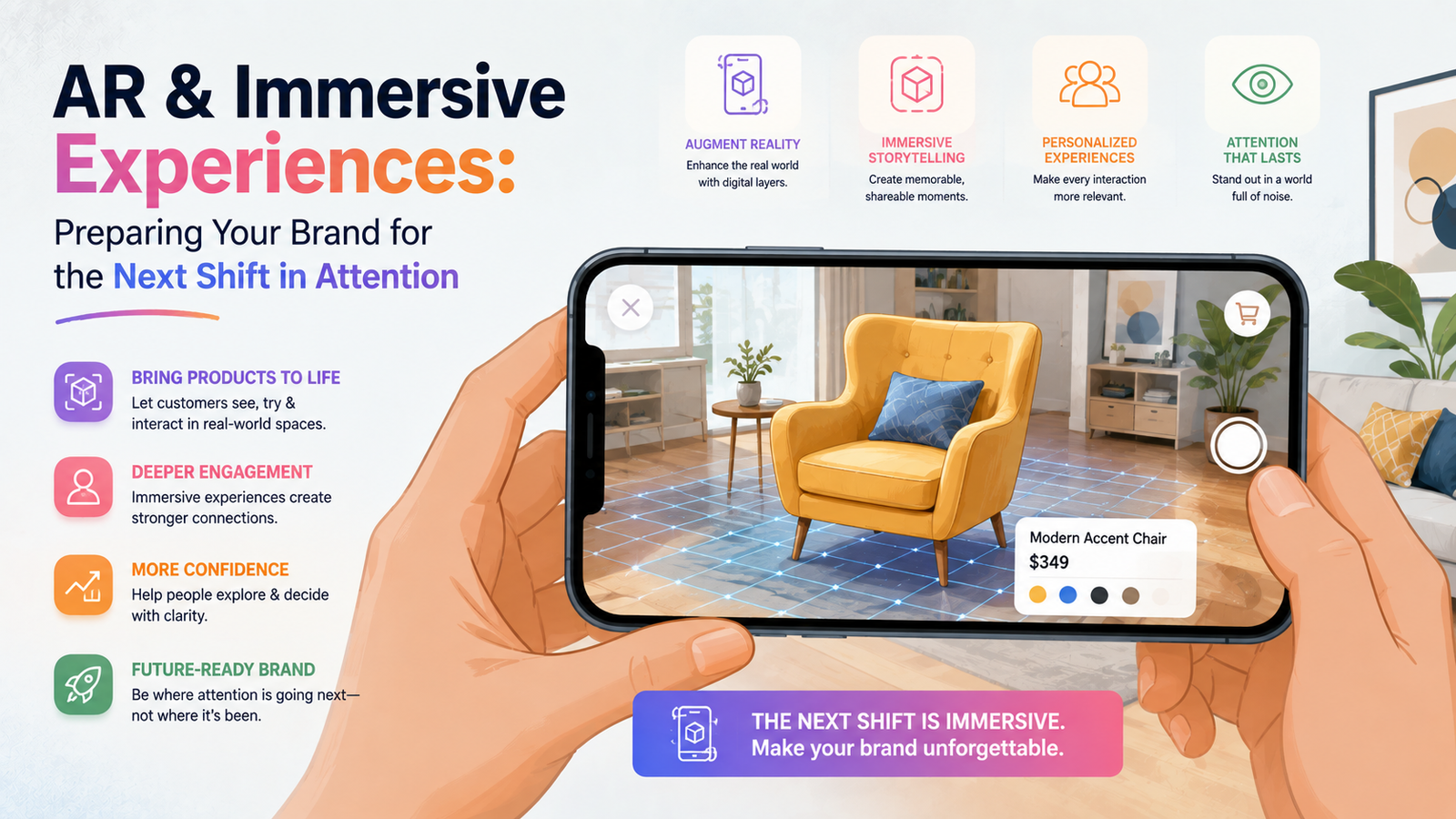
Immersive formats change the exchange. Instead of “look at this,” it becomes “try this.” A shoe that appears on your foot. A sofa that sits in your living room through the camera. A product demo you can spin and open without downloading anything. The attention isn’t longer because the tech is magical. It’s longer because the person is doing something instead of just watching.
I’ve watched teams burn money chasing the opposite approach. A mid-size apparel brand I worked with a few years back poured budget into a custom AR app. Beautiful product visualizations. Fancy packaging. They launched it with a big social push. Downloads were tiny. Usage after the first week was almost zero. Why? Because asking someone to leave Instagram, find an app store, install something, and then remember to open it is a terrible ask. The friction killed it before the experience even started.
That’s the pattern I keep seeing. Brands treat immersive as a destination instead of a moment inside the places people already are.
What actually works right now
Forget the headset talk for a minute. Most of the usable AR today lives on phones through platforms people already open daily. Instagram and Snapchat lenses. Web-based AR that loads in a browser with no install. Shopify and other platforms that let customers point their camera at the floor and drop a product into the room. Virtual try-on for beauty and eyewear. Simple product explorers that let someone rotate and zoom a 3D model without leaving the product page.
These aren’t futuristic. They’re available and relatively cheap to test.
A furniture retailer I advised last year skipped the custom app route completely. They added a basic web AR viewer to their top twenty products. Customer opens the product page on mobile, taps “View in your space,” and the chair or table appears on their floor through the camera. No download. No login. They measured the lift carefully. Product pages with the AR option saw higher time on page and a clear bump in add-to-cart for higher-priced items. Not a revolution. Just a useful tool that removed one common objection: “Will this actually fit and look right?”
That’s the bar. Does it solve a real friction or deliver a quick, enjoyable moment? If the answer is no, it’s decoration.
Another example. A skincare brand ran a simple Instagram filter that let people “try on” different shades and effects. Engagement was strong. Shares happened. But the team made one smart move: the filter ended with a clear next step—shop the exact shade or save the look. They didn’t treat the filter as the whole campaign. It was an entry point. Conversion followed because the experience was tied to an actual decision the customer was already close to making.
What usually doesn’t work
Chasing novelty for its own sake. Building something impressive that no one asked for. Measuring only views or shares while ignoring whether anyone moved closer to buying or becoming a repeat customer. Forcing AR into places it doesn’t belong just because a competitor did it.
I’ve also seen brands over-invest in production quality before testing basic utility. High-end 3D models are nice. They’re also expensive and slow. Start with good-enough assets and see if people even use the feature. You can always improve the fidelity later.
And please stop thinking every immersive moment needs to be branded entertainment. Sometimes the most effective version is purely practical. “See how this looks on you” beats “watch our cool branded experience” for most product categories.
Practical steps that don’t require a big bet
You don’t need a dedicated AR team or a six-figure budget to start preparing. You need to change a few habits.
First, audit your current customer path for moments of hesitation or imagination. Where do people need to picture the product in their life, on their body, or in their space? Those are the highest-value places for immersive tools. Product pages for furniture, fashion, beauty, home goods, and even some B2B equipment are obvious. Less obvious ones exist too—training materials, how-to content, event previews.
Second, use the platforms that already have distribution. Instagram and Snapchat make lens creation accessible. Many e-commerce platforms now have native or easy third-party AR viewers. Start there. Test one product category or one campaign. Track the metrics that matter: time spent, interaction rate, and downstream conversion or add-to-cart. Ignore vanity numbers if they don’t connect to business outcomes.
Third, treat immersive as one more format in the mix, not a separate strategy. Pair it with the same creative thinking you already use for video or static. Clear offer. Clear next step. Consistent messaging. The technology is just the delivery method.
Fourth, talk to your existing creative and media partners about what they can already support. A surprising number of agencies and freelancers have built filters or simple web AR in the last couple of years. You may not need to start from zero.
Honest limitations and watch-outs
Not every brand needs this right now. If your product is low-consideration or pure commodity, the payoff will be smaller. If your audience is older or less phone-camera fluent, adoption will be slower. Accessibility still matters—some people can’t or won’t use camera features, so always keep a non-AR path available.
Privacy and performance also matter. Camera access feels more invasive than a static ad. Be transparent. And make sure the experience loads fast. A laggy AR moment is worse than no AR moment.
Measurement is still messy. Platform metrics for lenses and filters don’t always line up cleanly with your CRM or analytics. You’ll need to get comfortable with directional data and controlled tests rather than perfect attribution.
Finally, don’t let the tech team or the agency own this alone. Marketing has to stay in the driver’s seat on the customer problem being solved. Otherwise you end up with impressive demos that never ship or ship to silence.
What to try this week
Pick one product page or one social campaign that’s already running. Ask a simple question: is there a moment where the customer has to imagine how this looks, fits, or works in real life? If yes, look at the lowest-friction way to add a try-on, place-in-space, or interactive 3D view. It might be a platform feature you already pay for. It might be a quick filter test.
Run it for two weeks. Watch the numbers that actually connect to revenue or qualified interest. Then decide whether to expand, improve, or drop it.
That’s it. No manifesto. No five-year roadmap. Just one concrete test that tells you whether this format helps your customers make better decisions faster.
Attention is shifting toward experiences that feel active instead of passive. You don’t have to bet the brand on headsets or virtual worlds. You do need to stop assuming that every interaction should look like the ones that worked five years ago. Start small, stay useful, and keep the customer’s actual friction at the center. The rest is noise.
