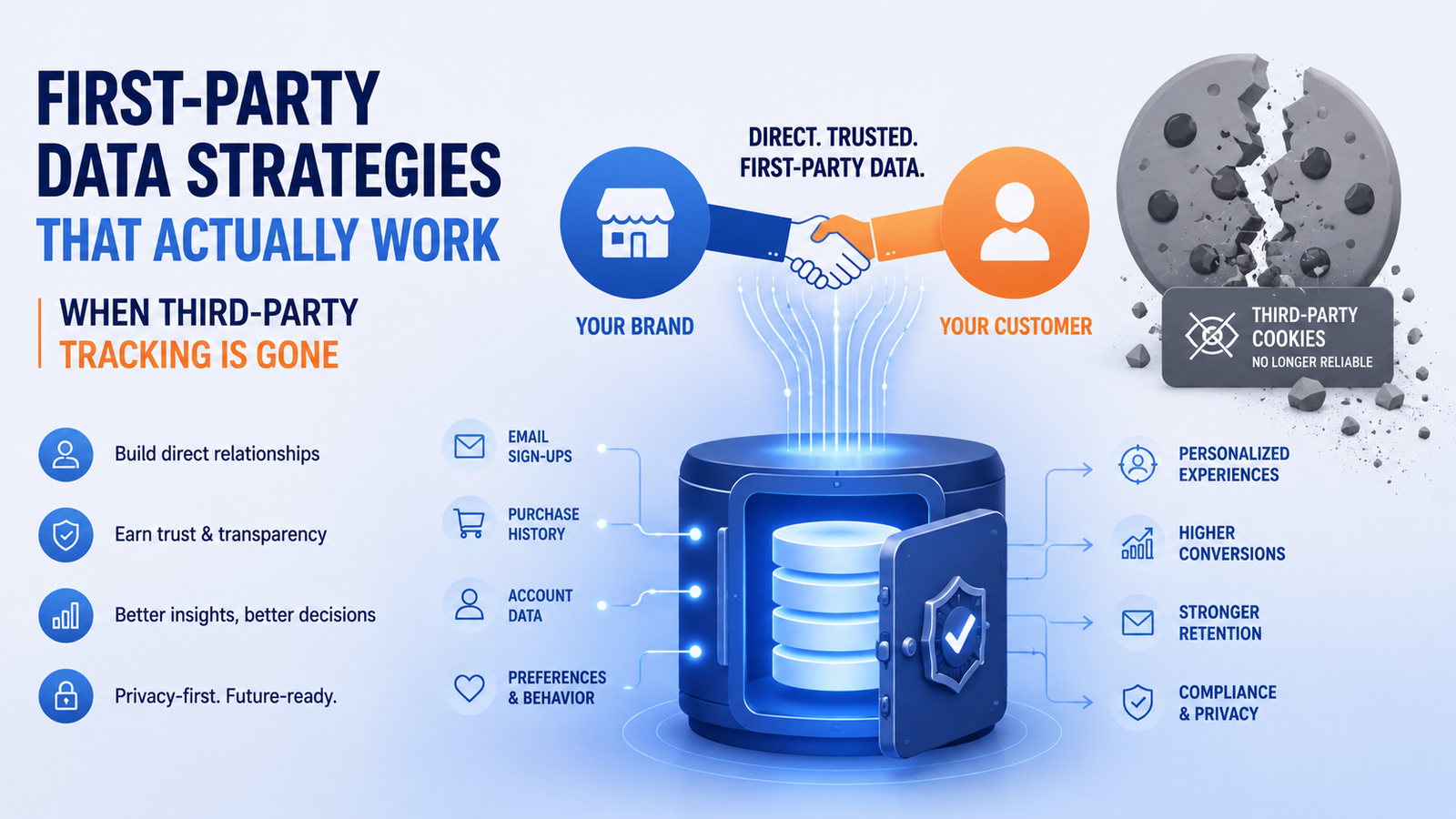
You’re probably sick of the cookie talk by now. Every conference, every LinkedIn post, every agency pitch starts the same way. Third-party tracking is dead or dying. Privacy rules tightened. Browsers locked things down. And your old measurement stack started looking like Swiss cheese.
I get the frustration. For years the industry ran on someone else’s data. You could drop a pixel, wait a few days, and feel like you understood the customer journey. That version of digital marketing is over. What’s left is first-party data—or nothing reliable.
The good news is this shift isn’t theoretical. Plenty of companies already adapted and kept (or grew) their results. The bad news is most of the advice floating around is still fluffy. “Build a data strategy.” Cool. How? Here’s what actually moves the needle when the third-party crutches disappear.
Stop treating first-party data like a side project
A lot of teams still treat email lists, customer accounts, and form fills as nice-to-haves. They’ll run a campaign, grab whatever leads come in, then go back to hoping the ad platforms figure out the rest.
That approach collapses the moment attribution gets noisy. I’ve watched brands lose 30-40% of their reported ROAS almost overnight after major privacy changes, then scramble. The ones that recovered fastest already had direct relationships with a meaningful chunk of their customers.
First-party data only works if you treat it as a core channel, not a byproduct. That means assigning someone real ownership. Not “marketing will handle the list.” Actual ownership: who cleans it, who decides what gets collected, who makes sure the data gets used in campaigns within days, not months.
One mid-size ecommerce brand I worked with had 180,000 emails sitting in a platform they barely touched. Open rates hovered around 12%. They treated the list as a place to dump promotional blasts. When third-party signals dried up, they finally cleaned the list, added a simple preference center, and started sending based on actual purchase history and stated interests. Within four months their email-driven revenue became the most stable part of the business. Nothing fancy. Just consistent attention.
Give people a clear reason to share
Nobody hands over their email, phone number, or preferences because you asked nicely. They do it when the exchange feels fair and useful.
Most brands still get this wrong. They put up a generic “subscribe for updates” form and wonder why conversion is terrible. Or they gate everything behind a form and create friction without delivering anything better than what was already free.
What works is specific value that matches the moment. A sizing quiz that actually recommends products. A short assessment that gives the user a personalized report. Early access to a restock or a private sale. A useful calculator or template that solves an immediate problem.
I once saw a B2B software company replace their long demo request form with a five-question diagnostic tool. Users answered a few questions about their current process and got a one-page scorecard plus three recommendations. The form completion rate jumped, and the sales team received far better-qualified leads because the data was self-reported and recent. Zero-party data (what people willingly tell you) often outperforms inferred data when you design the exchange properly.
Keep the ask proportional. Don’t demand a full profile on first visit. Progressive profiling works better: get the email first, then ask for more only when you’ve already delivered value.
Clean and connect what you already have
Collecting is the easy part. Most teams already have more first-party data than they use well. The problem is usually mess: duplicate records, outdated emails, no connection between purchase data and email platform, CRM fields that no one trusts.
Start with hygiene. Run a proper list cleaning process. Suppress obvious bad addresses. Match purchase and support data to the contact record. If your systems don’t talk to each other, fix the plumbing before you buy another tool.
A common failure I still see: companies invest in a customer data platform, migrate everything, then continue operating in silos. The fancy platform becomes an expensive archive. If your current tools can’t give you a basic single view of a customer’s email, last purchase, and recent site behavior, a CDP won’t magically fix the process problems.
Simple is often enough. Many smaller teams get further with a clean CRM, a solid email platform, and disciplined tagging than with an expensive stack they don’t fully use.
Measurement that still works (without the old tricks)
Attribution got harder. That doesn’t mean you stop measuring. It means you get more honest about what you can know.
First-party data lets you track people who are already in your systems with reasonable accuracy. Email clicks, logged-in site behavior, post-purchase surveys, and direct response campaigns still give clear signals. For the rest of the journey, accept more directional measurement.
I’ve watched teams waste months trying to rebuild multi-touch attribution models that no longer hold up. Better approach: focus on incrementality where it matters. Run holdout tests on email and SMS. Use geo or time-based experiments for paid media when possible. Track leading indicators you control—list growth rate, engagement depth, repeat purchase rate among known customers—alongside the lagging ones.
Also stop pretending every conversion needs a perfect last-click story. When a customer buys after receiving three emails and seeing two ads, the emails are often the durable part of the relationship. Treat them that way.
What usually doesn’t work
A few patterns keep showing up and failing:
- Collecting data with no activation plan. You get the email and then blast the same generic message for months. People unsubscribe or ignore you.
- Over-asking too early. Long forms kill conversion and often produce lower-quality data because people rush or lie.
- Buying tools before fixing process. Technology amplifies whatever system you already have—good or bad.
- Ignoring consent and preference management. If people can’t easily control what they receive, deliverability and trust both suffer. In 2026 that risk is higher, not lower.
- Treating first-party as a pure performance channel. The strongest results come when you combine it with brand and product experience. People share data more readily with brands they already like.
Watch-outs that matter
First-party data is powerful, but it has limits. You won’t have perfect visibility into cold prospects the way third-party used to (imperfectly) promise. Acquisition still requires some paid and organic reach. The difference is that the moment someone becomes known, you can treat them better and measure more reliably.
Privacy expectations keep rising. Collect only what you’ll actually use. Be clear about why you’re asking. Make opt-outs easy. The brands that treat consent as a checkbox eventually pay for it in reputation or compliance headaches.
And scale has a cost. A list of 50,000 highly engaged people often outperforms a list of 500,000 disengaged ones. Quality still beats volume.
One useful thing you can do this week
Pick one existing touchpoint where you already interact with customers or prospects—checkout, post-purchase email, account creation, or a high-traffic content piece. Add or improve a single, clear value exchange that collects or enriches first-party data. Keep the ask small. Make the benefit immediate and specific. Then make sure the data flows into a system someone will actually use in the next campaign.
Do that consistently for a few months and the “we have no data” problem starts looking smaller. The companies that treat first-party relationships as infrastructure, not a campaign tactic, are the ones still measuring and growing when everyone else is complaining about the dark.
That’s the practical shift. Not another strategy deck. Just better habits around the data you can still control.
